How to Reduce LLM Cost Without Losing Quality: A Finance-First Decision Ladder
Cut enterprise LLM spend without hurting output quality. A finance-first, 9-step decision ladder — from seat waste to model right-sizing to routing.



Reduce LLM cost by lowering cost per successful task while holding a pre-defined quality and latency floor. Start with that floor and a spend baseline, stop runaway usage, and remove seat, markup, and default-model waste. Then right-size models by task. Reach for caching, routing infrastructure, or fixed compute only when workload math justifies them.
Before you cut anything
Pick 50–200 representative tasks, set a pass/fail threshold, and name a rollback owner. Every lever below needs that quality gate before it's declared a win.
Most AI cost articles hand you a tactic list in no particular order. That's backward for a budget owner. Below is the order: cheapest and safest first, complexity last, only when the math earns it.
What should you cut first when AI spend spikes?
Don't blanket-switch to a cheaper model. Freeze runaway usage and define your quality floor first — most enterprises hit by a spike have neither one.
The Economist reported in June 2026 that companies are scrambling to curtail soaring AI costs, coining "tokenmaxxing" for unchecked usage — one big-tech executive called the coming squeeze "an absolute nightmare." Agents that read, interpret, and act burn more tokens than a chatbot; run across hundreds of programs, that spiral compounds fast.
The pattern repeats in team-level anecdotes: usage gets encouraged for months, costs triple almost overnight, and the bill was creeping up long before anyone with budget authority noticed. The fix isn't a panic downgrade — it's a baseline, a cap, and a floor, in that order.
What actually drives enterprise AI cost?
Enterprise AI spend is at least four different economic problems, not one — each needs its own audit question.
Worldwide AI spending will hit $2.52 trillion in 2026, up 44% year over year, according to Gartner, with the AI Models segment at $26.4 billion. Enterprise-specific: Menlo Ventures found LLM API spend doubled from $3.5 billion in late 2024 to $8.4 billion by mid-2025 — the most current published trend line.
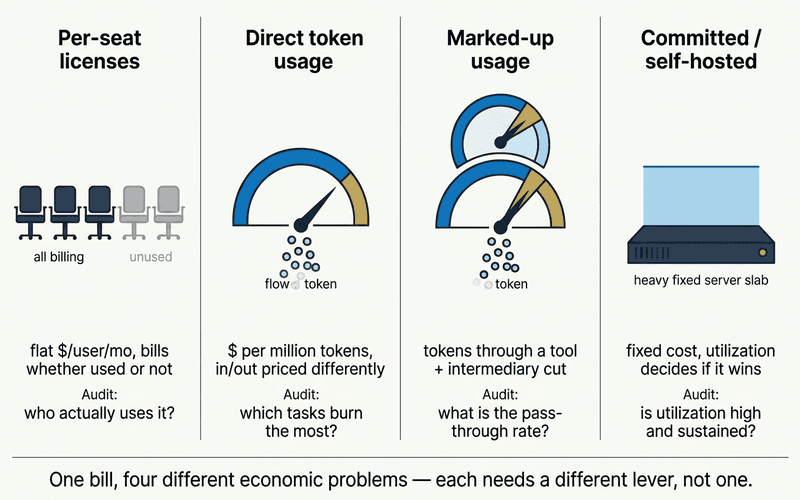
| Cost shape | How it bills | Typical range | First audit question |
|---|---|---|---|
| Per-seat licenses | Flat fee per user per month | $20–$25/seat/mo standard; $100–$125/seat/mo premium | Who actually uses it, and how much? |
| Direct token usage | Metered per million tokens, input/output priced separately | $0.14–$30 input per MTok across tiers | Which tasks burn the most tokens? |
| Marked-up usage | Token rate plus a tool or reseller's cut | Varies — often opaque | What's the actual pass-through rate over provider cost? |
| Committed / self-hosted compute | Fixed cost regardless of use | Case-by-case; depends on GPU utilization | Is utilization high and sustained enough to beat token pricing? |
Seat pricing spans a range: ChatGPT Business runs $20–$25/user/month, Claude Team prices the same, and Claude Premium runs $100–$125/seat/month. A seat on top of what Claude Code actually costs often means paying twice for the same work.
What does LLM cost optimization actually mean?
The governing metric is cost per successful task, not cost per token — a cheap request that fails and needs a retry can cost more than a pricier one that succeeds first time.
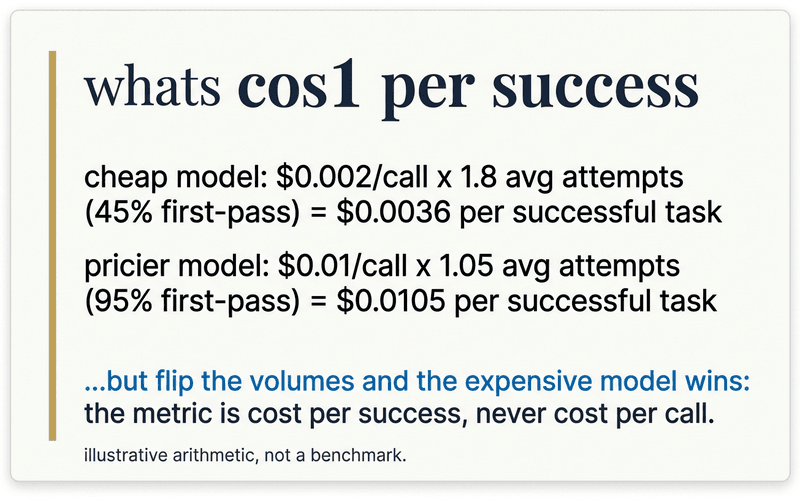
A $0.002-per-call model succeeding 45% of the time needs 1.8 attempts on average — $0.0036 per successful task. A $0.01 model at 95% success needs 1.05 attempts — $0.0105. Change the failure rate and the ranking flips; illustrative arithmetic, not a benchmark, but the direction holds in production.
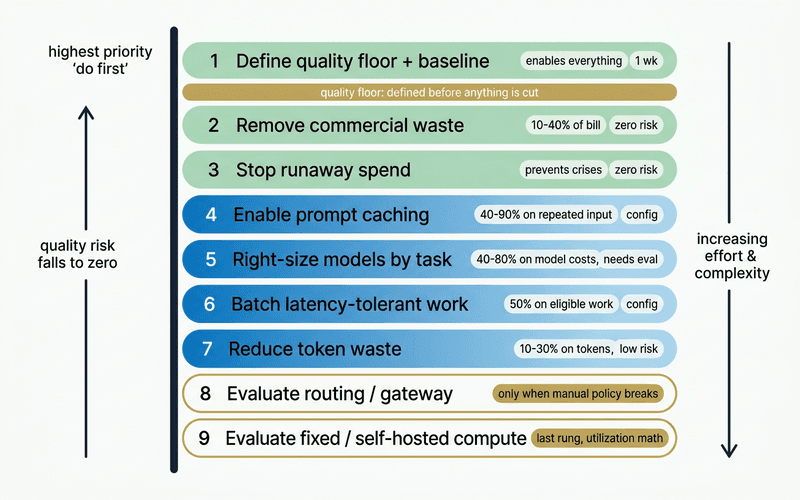
| # | Lever | Savings range | Quality risk | Effort | Proof required |
|---|---|---|---|---|---|
| 1 | Define quality floor + baseline | Enables everything below | None | 1 week | Golden eval set + cost-per-success metric |
| 2 | Remove commercial waste | 10–40% of bill | Zero | Days | Seat utilization audit |
| 3 | Stop runaway spend | Prevents crises | Zero | Days | Budget alerts + loop limits live |
| 4 | Enable prompt caching | 40–90% on repeated input | Zero | Config | Cache hit rate measured |
| 5 | Right-size models by task | 40–80% on model costs | Low–medium | 1–2 weeks | Golden eval pass rate at new tier |
| 6 | Batch latency-tolerant work | 50% on eligible workloads | Zero | Config | Eligible-volume audit |
| 7 | Reduce token waste | 10–30% on token costs | Low | 1–2 weeks | Output-token audit |
| 8 | Evaluate routing/gateway | 10–30% additional | Medium | 2–4 weeks | Manual-policy breakdown documented |
| 9 | Evaluate fixed/self-hosted compute | Variable | High | 4–8 weeks | Sustained-utilization math |
Steps 1–3 carry zero quality risk and take days; steps 8–9 carry real complexity and only get evaluated once the earlier steps are exhausted.
How do you stop runaway AI spend before it becomes a crisis?
Install budgets, per-team spend alerts, and agent loop limits before chasing a percentage anywhere else — config changes, not infrastructure projects, with zero quality risk.
A per-team or per-agent budget with an alert before overage, not after, catches a spike while it's still cheap to fix. A max-iteration cap on any agent loop stops one runaway automation from becoming the month's line item — exactly the scenario The Economist's "hundreds of software programs" framing describes.
The overcorrection is just as common: after months of encouraging AI adoption, some organizations swing to a flat per-user cap overnight. That protects the budget but also blocks a power user doing valuable work while a light user's allowance goes unused. Scoped alerts beat blunt caps.
Where is the commercial waste hiding in your AI bill?
Unused seats, reseller markup, and defaulting every task to the priciest model are pure waste — zero quality risk to remove, often 10–40% of the total bill.
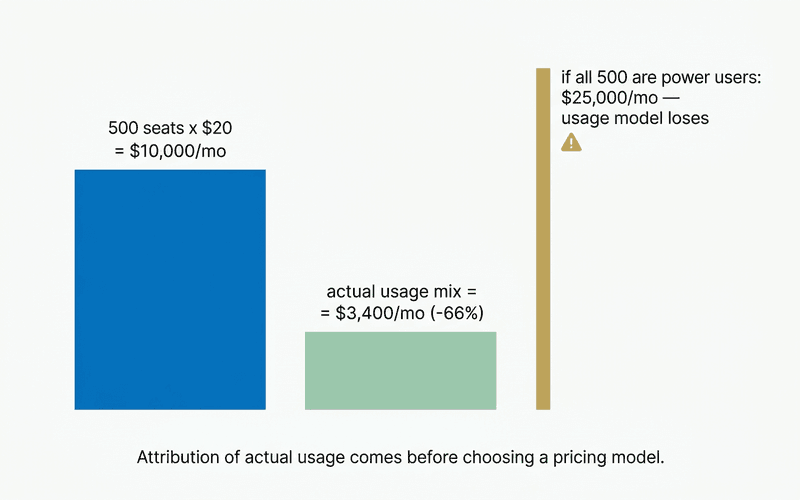
Run the seat math before assuming either model wins. A 500-person team on $20/seat/month seats pays $10,000/month flat. Usage-based billing on a realistic mix — 50 power users at $50/month, 450 light users at $2/month — totals $3,400/month, 66% cheaper.
But if all 500 are power users at $50/month, usage billing hits $25,000/month, 150% more than seats. The answer depends entirely on your usage distribution — attribution comes before you pick a pricing model.
The same waste hides in model choice: defaulting every task to your most capable model is a premium-default tax. Our breakdown of when the most expensive model isn't worth it covers which tasks don't need frontier-plus pricing.
How do you right-size models by task without losing quality?
Moving even part of a workload from a frontier model to a cheaper tier that still clears your quality floor is the single biggest lever here. Operationally, that means assigning a model per agent or task, not one default for everything.
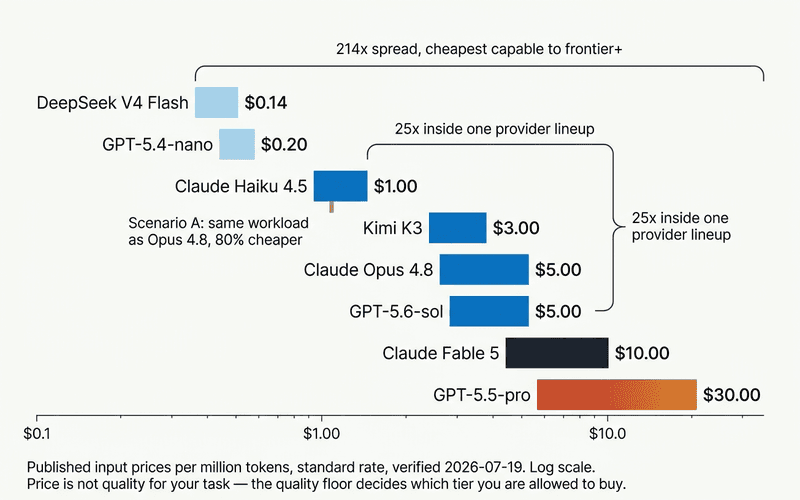
| Tier | Model | Input | Output | Ratio to cheapest |
|---|---|---|---|---|
| Budget open | DeepSeek V4 Flash | $0.14 | $0.28 | 1× |
| Budget open | DeepSeek V4 Pro | $0.435 | $0.87 | 3.1× |
| Mid proprietary | GPT-5.4-nano | $0.20 | $1.25 | 1.4× |
| Mid proprietary | Claude Haiku 4.5 | $1.00 | $5.00 | 7.1× |
| Mid open | Kimi K3 | $3.00 | $15.00 | 21.4× |
| Frontier | Claude Sonnet 5 (intro, through Aug 31 2026) | $2.00 | $10.00 | 14.3× |
| Frontier | Claude Opus 4.8 | $5.00 | $25.00 | 35.7× |
| Frontier | GPT-5.6-sol | $5.00 | $30.00 | 35.7× |
| Frontier+ | Claude Fable 5 | $10.00 | $50.00 | 71.4× |
| Frontier+ | GPT-5.5-pro | $30.00 | $180.00 | 214× |
After Aug 31, 2026, Sonnet 5 reverts to standard pricing at $3/$15.
At 10 million input plus 2 million output tokens a day, Claude Opus 4.8 runs $3,000/month; the same volume on Claude Haiku 4.5 runs $600/month — 80% cheaper on workloads that clear Haiku's bar. Our guide to choosing the right AI model per task covers that line; Kimi K3 pushes it further for structured work.
Right-sizing only sticks if it's a habit, not a one-time audit: someone needs to deliberately assign a model to each agent or task — the low-volume classification job on a budget tier, the customer-facing reasoning task on a frontier tier — and see, in plain dollars, whether that assignment is actually cheaper.
This is the operational form of everything above. Duet gives every agent in a workspace its own model choice across providers — OpenAI, Anthropic, and others — so right-sizing is a per-agent decision, not an all-or-nothing default.
Because Duet passes through token costs at cost, with no markup and no per-seat tax, the bill maps 1:1 to actual usage — the same spend-visibility problem that hides seat waste above doesn't happen here. Workspaces stay private, seats are unlimited, and the pricing model itself avoids the light-user/heavy-user subsidy problem described earlier.
Start a workspace and see the real per-agent cost.
Can caching and batching cut cost with zero quality risk?
Yes — caching and batching cut cost with zero change to model quality. Enable both before touching model choice.
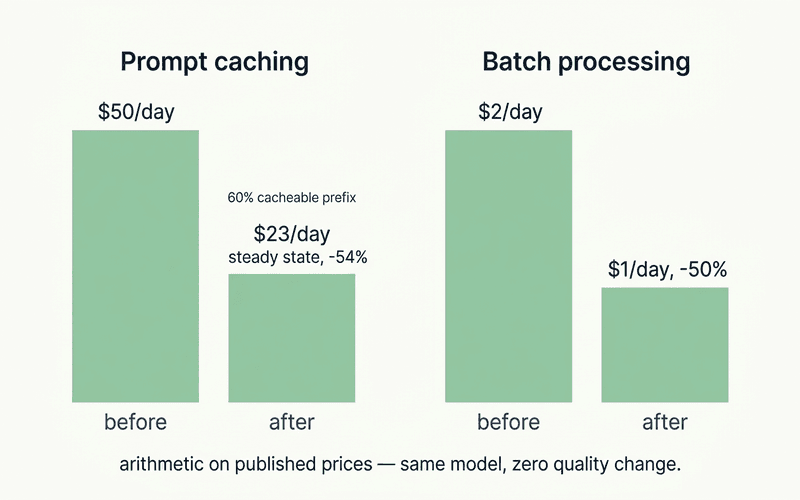
Anthropic's prompt caching gives a 90% discount on cache reads with one added request field; OpenAI applies the same discount automatically on prompts of 1,024+ tokens, no code changes. On a 10-million-token daily workload with a 60% cacheable prefix, steady-state cost drops from $50/day to $23/day — 54% off input costs alone.
OpenAI's Batch API and Anthropic's Message Batches both cut cost 50% flat for latency-tolerant work — evals, classification, bulk generation, embeddings. On 1 million tokens/day of batchable work, that's $2/day to $1/day, same model, zero quality change. If your app repeats system prompts or RAG context, this is a billing fix, not an engineering project.
When does model routing make sense — and when is it overkill?
Manual per-task model policy is enough for most organizations. Automated routing earns its complexity only once manual policy breaks under multiple teams, apps, and providers.
RouteLLM, a 2024 academic benchmark published at ICLR 2025, reported up to 85% cost reduction while holding 95% of GPT-4-level performance — but that figure is a specific MT-Bench configuration on GPT-4-era models, not a general production guarantee. It's also roughly two years old now; treat it as a directional research result, not an expected outcome for your traffic.
Vendor-modeled numbers push the same direction with less rigor: TrueFoundry reports that combining caching, routing, and on-prem shifts can "routinely deliver 50–80% cost reduction," including a hypothetical $150K-to-$60K/month scenario — a vendor-authored model, not an observed customer result.
For the mechanics of routing versus multi-model orchestration, see our deep dive on orchestrator-worker patterns versus model routing; for routing within the Claude family specifically, see Claude Opus vs. Sonnet model routing. Routing is one ranked lever here, not the first purchase.
When, if ever, does fixed or self-hosted compute make sense?
Committed or self-hosted compute only beats token-based pricing at sustained high utilization. It's not automatically cheaper, and it's the last rung to evaluate, not the first.
The break-even depends on GPU utilization and operations overhead most teams underestimate. In one widely shared account, a team said it was burning $50,000 a month on Claude and began evaluating a local, self-hosted swap to bring that down — real motivation, not proof self-hosting would win the math.
Run the utilization numbers before assuming fixed compute wins. No vendor-claimed self-hosting savings percentage should be treated as fact here — it's the last rung for a reason.
How do you prove a cost cut didn't hurt quality?
Every lever above needs a quality gate before it's declared a win: a golden eval set, a pass/fail threshold, a latency boundary, a named rollback owner.
Without that gate, "we cut spend 40%" and "we can't prove quality held" are the same sentence — a pattern real teams run into after the fact, not before it. Build the eval set from 50–200 representative tasks pulled from real production traffic, not synthetic examples.
Our guide on how we benchmark AI models on real work walks through building that test set instead of trusting leaderboard scores that don't match your workload.
Frequently asked questions
What's the difference between reducing LLM cost and just using AI less? Reducing LLM cost means lowering the cost of each successful task, not cutting usage indiscriminately. Blunt caps — a common first reaction to a spike — often suppress valuable work. The better lever is removing waste (unused seats, markup, oversized default models) and right-sizing models per task while holding a quality floor.
Is Claude or GPT cheaper for enterprise use? It depends on the task and tier, not the brand. Within OpenAI's own lineup, the spread between GPT-5.4-nano ($0.20/MTok input) and GPT-5.6-sol ($5.00/MTok input) is 25×; within Anthropic's, Haiku 4.5 ($1/MTok) to Fable 5 ($10/MTok) is 10×. The right question isn't "Claude or GPT" — it's which tier of either provider clears your quality floor for this specific task.
Does prompt caching actually save money, or is it marketing? It's a real, provider-documented discount. OpenAI applies a 90% discount to cached input automatically for prompts of 1,024+ tokens, zero code changes. Anthropic offers the same 90% discount on cache reads with one added request field. If your application repeats system prompts or RAG context across calls, which most production LLM apps do, this is available today.
Should we cap AI spend per user? A flat per-user cap is a blunt instrument — it stops catastrophic spend but can also block a power user doing valuable work while a light user's allowance goes to waste. Better guardrails: budget alerts scoped by team or agent, loop limits, and an exception process with a named owner and expiry date.
Is self-hosting an open-source model cheaper than API pricing? Sometimes, but only at sustained high utilization, and never automatically. Open-weight models like DeepSeek V4 Flash ($0.14/MTok input) are dramatically cheaper per token than frontier APIs, but self-hosting adds GPU utilization risk and operations overhead that token pricing doesn't carry. Run the utilization and total-cost math first; it's the last lever to evaluate, not the first.
How much can enterprises realistically expect to save? There's no single honest percentage — it depends on how much of your bill is seat waste, markup, or genuinely necessary frontier-tier work. What's verifiable: right-sizing from a frontier to a mid-tier model can cut that line item by roughly 80%, and caching or batching each cut 50–90% on the tokens they apply to, with zero quality risk. Vendor claims of blanket 30–80% reduction are vendor-modeled, not observed outcomes.