AI Automation Agency Guide: Build, Deploy, and Run Client Agents
A practical AI automation agency guide to scoping client agents, choosing runtime ownership, operating responsibly, improving the system, and planning a clean handoff.



An AI automation agency is a consultant or agency practice that delivers AI-enabled workflows or agents for a defined client business job. Doing this responsibly means deciding, in advance, who owns deployment, day-to-day operation, ongoing improvement, and the eventual handoff or retirement — not just shipping a working build.
A build is a project with a start and a finish line. A running client agent is an operating commitment with no natural end date — it reads data, sends messages, or takes actions on someone's behalf every day the contract is in force. The gap between those two things is where most agency engagements either become a credible service or quietly turn into a mess nobody agreed to.
Picture a small appliance-repair business. A boutique agency builds it a client agent that reads inbound quote requests, checks technician availability, drafts a reply with a proposed appointment window, and books the confirmed job. The demo works beautifully in a sandbox with ten sample emails. The question this guide actually answers is what happens on day 30, when a request looks nothing like the ten samples, a technician's calendar API changes its response format, or the client asks for a feature nobody scoped. That example is illustrative only — not a case study, not an outcome claim — but it's concrete enough to carry the whole argument.
What is an AI automation agency, and what happens the moment a build goes live?
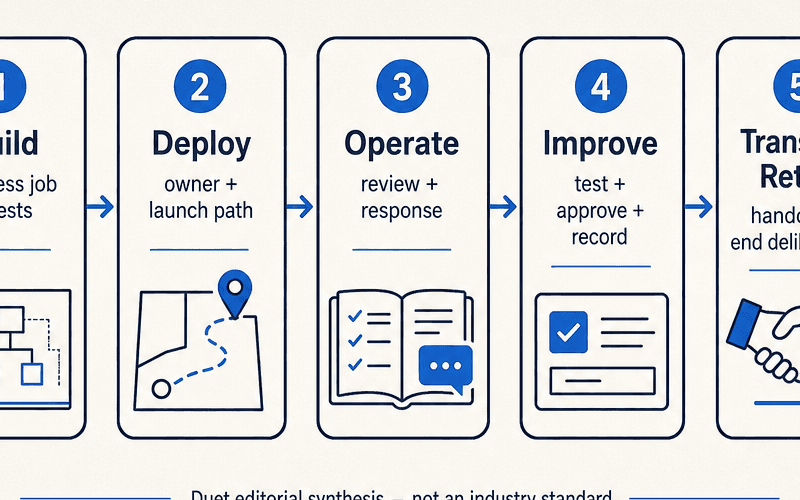
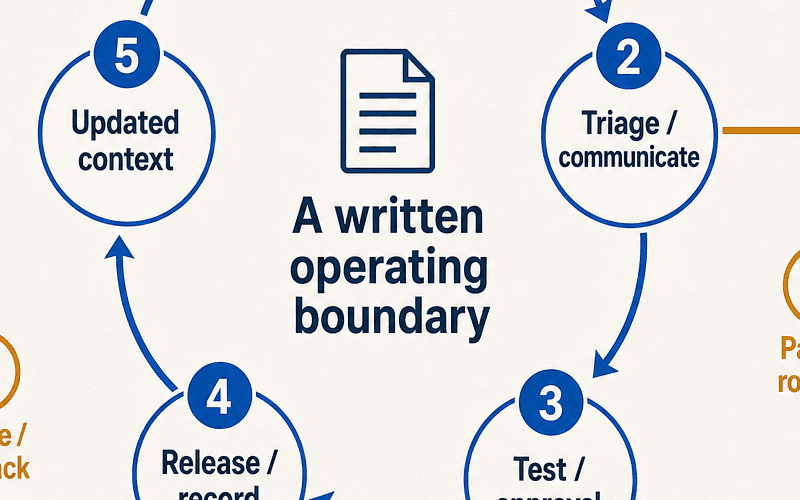
An AI automation agency delivers AI-enabled workflows or agents around a defined client business job, and its delivery model has to name who owns deployment, operation, improvement, and the exit path once that system is live. Think of these as five decisions a consultant makes across the life of an engagement — Build → Deploy → Operate → Improve → Transfer / Retire — a practical Duet editorial synthesis, not an industry, NIST, Anthropic, or Google standard.
"Live" is not a synonym for "done." A client agent that sends its first real message is a system someone now has to watch, someone has to be reachable when it misfires, and someone has to decide what changes and what doesn't. If none of that is written down, the agency hasn't shipped a service — it's shipped a liability with a demo attached. This is also where AI automation agency services earns its meaning: the word "services" only means something if the agency can point to a bounded set of responsibilities it has actually agreed to carry, not just an invoice for software access.
| Stage | Core consultant decision | Evidence of completion | What must not be assumed |
|---|---|---|---|
| Build | Define the business job, system behavior, tool boundaries, approval points, and representative tests. | The agreed version handles representative cases in a controlled setting. | That an agent is even needed, or that a build is production-ready. |
| Deploy | Choose runtime/account ownership, configure access and dependencies, define launch approval and a pause/rollback route. | A production owner, access path, launch criteria, and change path exist on paper. | That launch closes out the engagement. |
| Operate | Name review, triage, incident communication, and context-upkeep responsibilities. | A written operating boundary exists and both sides have seen it. | That monitoring catches every problem, or implies any coverage promise. |
| Improve | Test and release agreed changes to instructions, context, tools, permissions, workflows, or models. | Evaluations and approvals are recorded before consequential changes ship. | That every change is low-risk or immune to regression. |
| Transfer / Retire | Hand over or retire agreed assets, schedules, access, and responsibilities. | The client accepts the transfer; agency access is removed as agreed. | That handing over source code is a complete handoff. |
Every later section in this guide is really an elaboration of one row in that table.
What should an agency actually build — and when is an agent overkill?
Start with a specific business job, decide what stays human-owned, and pick the smallest system that fits it: a predictable workflow is often the right call for well-defined tasks, and an agent earns its complexity when the work genuinely needs flexible, model-directed decisions. That second half matters more than it sounds — plenty of "agent" projects are workflows wearing a mask, and plenty of genuine agents get built for jobs that never needed the extra unpredictability.
Before writing a single prompt, a consultant can answer six questions in plain language: Who is this for? What triggers it? What does a good output look like? What result is unacceptable? What tools or actions is it allowed to touch? And where's the human approval point? Add a short set of representative test cases — normal, edge, refusal — and the build phase has an actual finish line instead of a vibe. Going back to the repair-shop example: the trigger is an inbound message, the tools are a calendar lookup and a draft-reply action, the unacceptable result is booking a slot the technician doesn't actually have, and the approval point might be a human glance before the first message ever sends to a real customer.
Anthropic's guide to building effective agents makes this same case from the engineering side: start with the simplest solution that meets the use case, treat predictable workflows as the default for well-defined work, and reserve agents — with tools, retrieval, and memory layered on — for cases that need more flexible, model-directed judgment. Anthropic also flags that autonomous agents can compound errors and cost, which is exactly why they recommend real sandbox testing and guardrails before anything touches production. None of that is a guarantee that any specific build is ready; it's a reason to earn the complexity rather than default to it.
Once the business job and its boundaries are clear, the packaging question — what the agency actually sells as a first offer — is worth working through on its own: Package Your Expertise Into an AI Agent.
What actually changes the moment a build deploys?
Deployment is the move from a tested build into an intended production arrangement, and it forces explicit answers about account ownership, access, dependencies, launch approval, and a way to pause or roll back. It is not evidence that the agency can now walk away.
This is the point where a lot of engagements quietly lose their shape. The build phase has a natural checkpoint — the demo either works or it doesn't. Deployment doesn't have that same clean signal, because the system that looked finished in a sandbox is now touching a live inbox, a real calendar, or an actual customer conversation, and every one of those integrations is a place where responsibility has to land on somebody by name. NIST's Generative AI Profile lists post-deployment monitoring, incident response, recovery, change management, and decommissioning among the risk-management considerations worth planning for — voluntary guidance, not a certification, and nothing here should be read as a claim that any deployment is "NIST compliant." What it's useful for is a checklist of the categories a consultant should have an answer to before flipping the switch, even if the answer for a small engagement is intentionally lightweight.
Should the client or the agency own the runtime and the accounts?
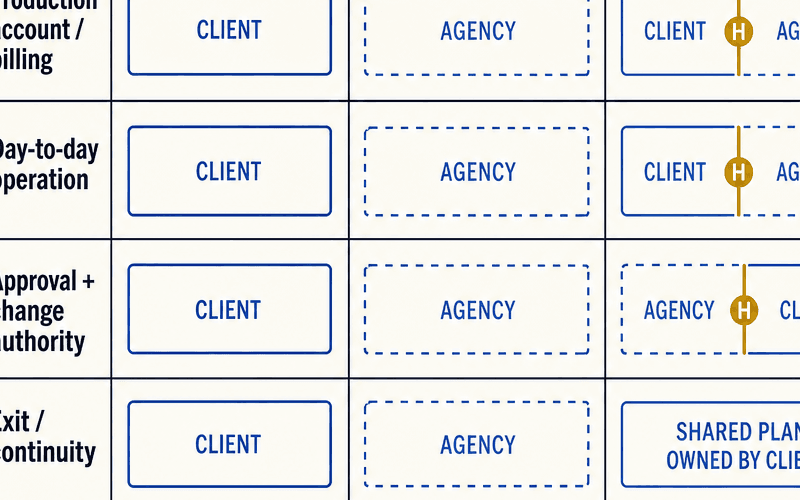
There's no default winner here: client-owned, agency-managed, and hybrid arrangements each trade off differently across control, access, billing, portability, client capacity, and who's actually accountable when something goes wrong.
| Arrangement | Who owns the production account/runtime? | Useful when | Responsibility to make explicit | Trade-off to name |
|---|---|---|---|---|
| Client-owned | The client holds provider accounts, billing, and admin control; the agency gets scoped access. | The client wants direct control, has internal technical ownership, or cares about continuity after the engagement ends. | Admin owner, access grant/revocation, vendor notices, change authority, succession. | More coordination overhead; client-side changes can break the live system without warning. |
| Agency-managed | The agency runs the production environment and grants the client agreed visibility and approvals. | The agency is deliberately selling managed operation and the exit terms are written down. | Client separation, access, billing transparency, response ownership, portability, departure. | The agency now carries real operational weight; shared infrastructure must not blur data or privileges between clients. |
| Hybrid | The client keeps high-consequence systems and core accounts; the agency operates an agreed runtime layer on top. | The client wants control boundaries but doesn't have day-to-day operating capacity. | Alert ownership, billing, permissions, approval rights, handoff sequence. | Split ownership creates gaps unless the seam between the two sides is documented. |
Six questions cut through most of the ambiguity here: What can the agent actually read, write, or send? Which of its actions carry real consequences if they go wrong? Who holds the provider contracts and pays the bill? Who could operate this without the agency in the room? What has to move at offboarding? And who can approve — or pause — a production change? If an agency runs multiple clients on shared infrastructure, tenant isolation stops being an assumption and becomes a design decision; AWS's guidance on tenant isolation treats this as foundational for shared SaaS, with the actual implementation depending on domain, compliance needs, and architecture — a general consideration, not proof that any particular agency setup is isolated or secure.
The deeper mechanics of where and how to actually host a client agent are their own subject: Where to Host AI Agents.
What does "operating" an agent actually require once it's live?
A managed client agent needs a written runbook naming what gets checked, who owns the response and the client conversation, what's allowed to change, how context stays current, and exactly where the agency's responsibility stops.
That runbook doesn't need to read like a compliance document to be useful. Ten things belong in it: the service definition and its explicit non-goals; named owners on both sides plus an escalation contact; an inventory of assets and dependencies; the access and revocation path; launch acceptance criteria and a pause/rollback route; the signals actually reviewed, on what cadence, and the limits of that monitoring; an incident lead, client communication route, working record, and containment path; the change classes allowed, their tests, approvals, and rollback; the authoritative sources for context and who owns keeping them current; and an offboarding inventory. For the repair-shop agent, that might mean: someone checks failed bookings and escalated messages daily, the technician's manager is the incident contact, and a double-booked slot triggers an immediate pause on new confirmations until it's fixed.
Say this plainly to clients, because it's true: monitoring only covers the signals you define and act on — it is not a reliability guarantee. Google's incident-response guidance separates fixing the technical problem from managing the response itself — coordination, communication, a clear lead, a working record — and that split is worth borrowing even for a two-person shop. It doesn't require a large-company command structure or an SLA to be useful; it just requires naming, in advance, who does what when something breaks.
Naming that structure is also what turns "we'll keep an eye on it" into a service someone can actually be accountable for: Who Runs Your AI Agent After You Build It?
How do you change a live agent without losing control of it?
Treat every change to prompts, context, tools, permissions, workflows, or the underlying model as a change to a live service: test it against representative cases, run it through the agreed approval path, record what shipped, and keep a way to roll it back.
Four change classes make this easier to reason about: an operational correction (fixing something that's clearly broken), a behavior or content change (adjusting tone, scope, or output style), a capability or permission change (giving the agent new tools or wider access), and emergency containment — pause the schedule, revoke a connection, disable a tool, roll back a release, and sort out the root cause afterward. Context sources, instructions, and tool descriptions are maintained dependencies, not a one-time training pass; the repair-shop agent's understanding of "which technicians work Saturdays" will drift the moment the client changes staffing, and nobody will tell the agent unless someone owns that update. OpenAI's evals guidance is useful here in spirit: keep a small, representative test set for the business job and rerun it before consequential changes ship — that discipline catches regressions, though it never guarantees quality, safety, or reliability on its own.
Permissions deserve the same discipline: give agent actions the smallest set of permissions that actually does the job, keep a revocation path within reach, and put genuinely high-impact actions — sending money, deleting records, messaging a client's entire list — behind an approval step. OWASP's prompt-injection guidance describes how both direct and indirect prompt injection can arise, including from content the agent merely reads, and recommends constrained behavior and least privilege to reduce the blast radius. It does not claim a foolproof fix, and neither should anyone using it as a reference.
When does this become a real recurring service instead of vague maintenance?
A recurring service is credible when it names actual continuing work — defined review, incident triage, approved changes, context upkeep, documentation, or reporting — rather than folding every post-launch request into a catch-all called "maintenance."
Scope grows or shrinks based on a handful of real variables: how many workflows are live and how critical each one is, how sensitive the data and integrations are, who owns the runtime, how often anyone actually reviews the system, how much change is allowed without a new conversation, and how much documentation or reporting the client expects. What sits inside that scope should be explicit, and so should what doesn't: new integrations, expanded permissions, net-new features, provider costs, data migration, a formal security or compliance review, round-the-clock coverage, and any recovery-time commitment are all separate conversations, not line items buried in a flat monthly fee.
Turning that boundary into an actual retainer — what to charge for it, how to package it — is a distinct question worth its own answer: Turn AI Agent Builds Into Recurring Retainers.
How do you end an engagement cleanly?
A clean exit deliberately transfers or ends the operating responsibility: inventory the assets, reassign or revoke access, transition or disable schedules, document who the final owner is, and get the client's acknowledgment as agreed.
Code is the smallest part of a real handoff. What actually needs to move includes the instructions and context sources, the workflow or configuration itself, the evaluation/test cases built up over the engagement, account and integration settings, the schedule and trigger inventory, documentation, and credentials or authorizations. Skip any of those and the client inherits a system they can't actually run — which is its own kind of failure, even if the original build worked perfectly. The specifics of data handling, deletion, retention, and what the contract actually requires depend entirely on the engagement; nothing here should be read as legal, compliance, privacy, or security advice.
Before selecting any runtime or workspace to help run all of this, write down the operating boundary first: who owns the accounts, what gets reviewed, who approves changes, and how the client eventually takes the system over or retires it. That sequencing — boundary first, tooling second — is the difference between choosing infrastructure that fits a real commitment and choosing infrastructure that just looks capable in a sales call.
Frequently asked questions
What is an AI automation agency?
It's a consultant or agency practice built around delivering AI-enabled workflows or agents for a client's specific business job — and stopping there isn't enough. The delivery model also has to spell out who owns deployment, day-to-day operation, ongoing improvement, and the eventual handoff or retirement, so "it works in the demo" never gets mistaken for "the engagement is done."
What services does an AI automation agency provide?
Services can include defining a business job, building a workflow or agent that fits it, deploying it into an agreed runtime and account arrangement, and — only where explicitly agreed — operating, improving, documenting, and eventually transferring that system. The scope should name the actual work rather than hiding behind the word "maintenance."
Is an AI agent always better than a workflow?
No. Anthropic recommends starting with the simplest solution that fits the use case: workflows tend to suit well-defined, predictable tasks, while agents fit work that genuinely needs flexible, model-directed decisions. The right choice follows the client's job, the actions it's allowed to take, and how much review it needs — not a default preference for the more sophisticated option.
Should the agency or the client own the AI agent runtime?
Neither is automatically correct. Compare client-owned, agency-managed, and hybrid arrangements against control, access, billing, portability, the client's own capacity, and which party is actually prepared to own the consequences after launch.
What should be included in an AI agent operations runbook?
A useful runbook names the service boundary, the owners and escalation contact on each side, the assets and dependencies involved, the access and revocation path, launch acceptance criteria, the signals actually reviewed, the incident communication process, change controls, how context stays current, and the offboarding plan. It should fit the engagement, not double as a guarantee or a certification.
How can an AI automation consultant offer a recurring service without vague maintenance?
Anchor the offer to work that's actually happening on a schedule — a review cadence, an incident-triage process, an approval path for changes, someone keeping context current, and a reporting rhythm the client can see. Whatever isn't included should be said out loud, not discovered later: new integrations, added capabilities, wider permissions, and promises like round-the-clock coverage all deserve their own conversation and their own scope.